Showing posts with label Justin Yao. Show all posts

Wednesday, March 16, 2011

This Bud's For You

Eating has always been one of the simple joys and pleasures in life that has been there since the dawn of mankind. Beginning from the tough uncooked meat and vegetables our large-jawed ancestors had to chew on every day, we now have such a wide variety of different cuisines and unique food dishes that we can fill our stomachs with. Although we may form preferences for certain tastes or types of food, all the world’s cuisines are an all-you-can-eat buffet that can tickle our taste buds in many different ways. Just so long as you are adventurous enough to try, that is.

Mmmm, exotic food...

Nowadays though, many people take this for granted and choose to deprive themselves of the simple pleasure of eating. In our fast-paced and competitive world, many people choose to forego eating breakfast, which is often said to be the most important meal of the day. Also, in a society that places a major emphasis on one’s body and figure, food is generally viewed as the principal obstacle to overcome to attain their desired weight loss, hourglass figure, and six-pack abs.

It is a common assumption that people who are more sensitive to taste, or supertasters, are more likely to have higher food consumption than regular tasters or non-tasters (“taste blind”). The most likely line of reasoning is that, because the taste sensation they experience is a lot fuller, richer, and more intense, they are more likely to eat a lot more than the typical, non-supertaster individual. But apparently, the way we are able to taste and enjoy the flavor of our food is not a hindrance to the model-esque body we long and desire for.

In a 2007 study conducted by Sitton and Sullivan, they studied the relationship of one’s sensory acuity to their tendency to binge eat. Acuity for the sense of taste was measured in terms of the number of fungiform papillae on each participant’s tongue, while olfactory acuity was measured using the University of Pennsylvania Smell Intensity Test (UPSIT). Values were also obtained for the participants’ body mass index (BMI) and from the Binge Eating Scale.

Just look at the size of those papillae!

Contrary to the belief that having a richer taste experience leads to eat more, they found that those with higher sensitivity for experiencing flavor actually had the lowest BMIs among the participants. It is believed that, because the supertasters are able to experience more intense flavors than non-tasters, they become more quickly satiated. In addition, because their threshold for being able to detect and recognize tastes are lower, supertasters may also be able to observe a high-fat diet that leads to a quicker feeling of satiety. In being distinguish the high-fat food from the low-fat food, the supertasters can ultimately consume less calories than the non-tasters. Although increased sensory acuity should also predict supertasters avoiding certain bitter foods, no difference was found between their food preferences as compared to non-tasters.

High-fat goodness!

Although there is a solid logical link that connects food to higher weight, apparently, this logic isn’t as sound as originally believed to be. Factors such as genetics and amount of physical activity can influence one’s build or body frame, but then, one’s ability to experience flavor may also spell the difference between a beer-belly and a well-defined abdominal area.

This is what some people get from all-hotdog diets.
Life is unfair.


Sitton, S.C., & Sullivan, A.F. (2007). Sensory acuity and binge eating. American Journal of Psychological Research, 3(1), 29-33.


Images from:
http://www.eatsleepgeek.com/
http://www.popularwealth.com/
http://jenruhman.blogspot.com/
http://groundframe.com/

Friday, March 4, 2011

You're Just Too Good To Be True, Can't Keep My Hands Off Of You


Recent discussions in one of my psychology classes discussed the issues surrounding the public display of affection (PDA), particularly that of same-sex couples. Needless to say, most reactions toward it were that of uneasiness, discomfort, and, to a more extreme level, disgust. But regardless of the sex of the people involved in the incident of PDA, the action itself is generally viewed in a negative light. Though being cuddly and loving in a public area may receive reactions of the couple being sweet, couples who grope around and are more torrid with each other get reactions that are typically along the “get-a-room” variety. This literally touchy topic receives a lot of flak, being in the public sphere and all, but there may be an underlying reason to their public displays of affectionate behavior.

Acceptable vs. Unacceptable

A 2007 study published in the Canadian Journal of Experimental Psychology presents support for the idea that there are two major classes of the sense of touch. These are namely discriminative touch, which deals with interpreting tactile information to be able to recognize objects and to feel sensations, and emotional touch, which involves the affective component of pleasantness or pleasure derived from the sense of touch. They relate findings of physiological evidence that show there are different types of mechanoreceptors that respond differently to certain stimuli, which are then transmitted to different nerve fibers of varying properties.

There have been more studies documenting the functions of the mechanoreceptors used for (discriminative) touch, pain, temperature, and itch. Most of these low-threshold mechanoreceptors are located in glabrous (hairless) skin areas, such as the palm and the sole of the foot, and travel along heavily-myelinated nerve fibers, called A-fibers (alpha/beta/delta), that are coated with a thick layer of fat that facilitates impulse conduction. There are 4 types of these mechanoreceptors, each of which are responsible for the perception of certain sensations on the skin.

Not as much attention has been devoted to the study of the affective component of touch, which was found to have its own separate pathway for conducting tactile sensations. The specialized CT system, which is found only in areas of the skin with hair, respond best to slowly moving, low-force, mechanical stimuli. Signals travel along unmyelinated C-tactile afferent (CT-afferent) fibers that provide or support emotional, hormonal, and behavioral responses to skin-to-skin contact with con-specifics. In addition, these fibers project into areas of the brain that are associated with the affective aspects of feeling from the body, such as well-being and rewards. In combining the input from both A-fibers and CT-fibers received from the hair-covered areas of skin, a fuller sensation of pleasantness derived from touch may be experienced.

Reading this article explains, in a rather nerdy manner, why some people publicly have their hands all over their significant other in places no one else will find. Despite this strong evidence for the body having a system that for touch serving an emotional need, like most behaviors, the acceptability of PDA is usually determined by the context it is done in. Perhaps getting inspiration from the saying that actions speak louder than words, gently caressing your significant other’s body, public or otherwise, can say so much more to the CT system than any cheesy line can ever manage.


McGlone, F., Vallbo, A.B., Olausson, H., Loken, L., Wessberg, J. (2007). Discriminative touch and emotional touch. Canadian Journal of Experimental Psychology, 61(3), 173-183.

Images from:
http://www.sporati.com
http://www.cartoonstock.com

Saturday, February 19, 2011

"Blind as a Bat?" NAT!


Because of the several med school interviews I was anticipating, I was trying to reflect more on all sorts of random things. True enough, one hypothetical question that was asked concerned becoming paralyzed from the neck down and my corresponding reaction to that predicament. Being the physically active person I am, I would obviously be devastated if I were to lose my ability to move around from place to place using my own two feet and to play around and tinker with things using my hands and fingers. After this, I thought about which of the five senses I would be most unable to live without. The popular choice of the most difficult sense to live without is the sense of sight. It must definitely be really hard to imagine living in constant darkness, unable to see the richness of the world. Apart from that, vision is often needed to perform basic tasks with a certain amount of precision. I may need glasses and contact lenses to help correct my slightly impaired vision, but it is a compromise I am willing to make in order to enjoy all the visual pleasures out there.

Most people know of bats that are practically blind, being able to compensate for their poor vision by using a technique called echolocation (Stroffregen & Pittenger, 1995). Similarly, dolphins usually rely on their built in sonar systems to navigate the underwater terrain. These examples present two contrasting examples are demonstrations of the application of the ability to use echoes to analyze the features of a certain scene. Bats rely heavily on this ability to navigate while flying, and dolphins may use this to supplement the visual stimuli they receive or resort to when there is a lack of visual information.

Robin: "Batman, better leave the driving to me next time."

With this being the case, being without sight isn’t all that bad, after all. In a recently published 2011 study, researchers found evidence for sighted people being able to quickly learn how to interpret auditory information contained in echoes to allow for size and position discrimination in a given scene. They performed two separate experiments, each of which was used to assess the level of the echolocation ability of the participants. One result was that the size discrimination threshold was relatively constant with increasing distances. This is because the size of the angle, rather than distance, is what mainly determines the ability for size discrimination. The other experiment used a novel vernier stimulus presented to the participants to measure the spatial resolution of their echolocation ability. It was shown that training can produce improvements in the proficiency of sighted people in the use of echolocation. These improvements ranged from gaining a crude ability to echolocate, to nearly approximating the skill level of a blind individual in using echolocation.


Going back to my reflection on what sense I cannot live without the most, perhaps I would still stick with the sense of sight (however, I have also read about a compelling argument that the sense of hearing is a more indispensable sense modality). Although I am hoping that I won’t have to rely on it full-time out of necessity, learning how to use echolocation to navigate through a scene and to be able to discriminate between the objects present in it is a skill that I would definitely want to learn. Aside from the practical applications, I think it can actually be quite fun too to be able to do things in the dark. ;)

Paper beats rock!

Teng, S., & Whitney, D. (2011). The acuity of echolocation: Spatial resolution in sighted persons compared to the performance of an expert who is blind.  Journal of Visual Impairment & Blindness, 105(1), 20-32.

Stroffregen, T.A., & Pittenger, J.B. (1995). Human echolocation as a basic form of perception and action. Ecological Psychology, 7(3), 181-216.

Images from:
http://www.flickr.com (Allard62)
http://www.fanpop.com

Friday, February 4, 2011

Ravishing Red


With Chinese New Year just recently concluding, there was a definite increase in the number of people wearing vibrant red shirts and blouses. Although most Filipino-Chinese people typically have just one big dinner celebration commemorating this event, I had two of these said dinners on consecutive evenings. In those Chinese restaurants we ate at, there was no shortage of festive spirit, tasty (and very oily) Chinese food, and people in bright red clothing. The Chinese culture’s preference for the color red is a very old tradition that is rooted in the belief that the color brings the wearer prosperity, good fortune, happiness, and long life. These are arguably the things that most people would want to possess in their lifetime, and all for the simple task of walking around looking like a giant tomato. But perhaps there is another reason why the Chinese are so fond of the color red, and they may not even be aware of it.

A study was reported in class which had findings that support the idea that men perceive women around the color red, either in their clothing or in front of a background, as more physically attractive. Aside from physical attractiveness, the women were also seen as more sexually desirable, while men were more willing in asking these women out and spending more money when on a date with them, among other things.

Red + Woman = Sexy

Although the findings may seem to give women an unfair advantage, a recent 2010 study shows that women likewise perceive men to be more attractive and sexually desirable when seen on a red background and in red clothing. This “red effect” was also shown to have an association with the males’ perceived rank or status. The men being seen in the color red only affected women’s romantic attraction towards them, while it did not affect in any way the women’s perception of the men’s overall likability, agreeableness, and extraversion. Red also did not influence the men’s perception of other men in this study. Despite being unaware of the true nature of the experiments they took part of, the results show that the color red was able to subtly alter their perceptions of a man’s attractiveness.

Some explanations the study presented to account for this effect was that women are more sensitive than men in detecting red. This may include being able to perceive faint changes in the coloration of a man’s face due to increased blood flow, as well as an enduring red coloration that may indicate general good health. It is possible that the red effect may have its strongest influence on females when they are at their most fertile point in their ovulatory cycle, when they have a strong preference for males with masculine features. And because, more often than not, a confident man is a sexy man, their choosing to wear red may also enhance their own perceptions. In displaying deep red colors, a man’s sense of power or status may subtly grow, in turn affecting his thoughts, feelings, and actions.

The image of masculine sex appeal.

The results obtained from this series of experiments are interesting in that the “red effect” is also supported by empirical data. Because of the pervasiveness of the color red in the Chinese culture and tradition, it now kind of gives a plausible explanation as to why China is the most populous nation in the world. It is really rather amazing that something so simple as the color of one’s shirt may have such profound effects on the attraction patterns for human beings. With another significant February holiday fast approaching, it is now easy to understand as to why red is color of choice for this event experienced both by lovers and lovers-to-be alike.

Red working its magic.

Elliot, A.J., Niesta Kayser, D., Greitemeyer, T., Lichtenfeld, S., Gramzow, R.H., Maier, M.A., Liu, H. (2010). Red, rank, and romance in women viewing men. Journal of Experimental Psychology: General, 139(3), 399-417.

Images from:
http://www.girls-t-shirts.com
http://letscolourproject.com
http://www.topchinatravel.com

Saturday, January 22, 2011

Driving Off Into the Sunset

The Philippines may be renowned for many things, but one thing that people may not really know is that it is arguably home to the best drivers in the world. Filipino drivers regularly face horrifying traffic, depressing road conditions, and questionably moral traffic officers. In addition to this, they have to contend with all sorts of drivers. There are bus drivers who have a fondness for drag racing, jeepney drivers who constantly switch lanes as if they were rushing to go to the bathroom, motorcycle drivers who keep weaving in and out of traffic with reckless abandon, just to name a few. Aside from these driver stereotypes, there is also the notion of lolo and lola drivers taking their leisurely time in the car while a kilometer’s worth of road behind them is filled with angry, impatient drivers.

In a 2007 study conducted by a large team of researchers, it was found that elderly drivers with impaired visual attention are more likely to avoid driving than unimpaired drivers. Older drivers who had an elevated risk of having car accidents practiced self-regulation of driving more than their low-risk counterparts. Although elderly women were more likely than elderly male drivers to avoid challenging driving situations, it was found that both male and female participants had similar tendencies of modifying their frequency of driving when impaired visual attention factored in. The males’ inclination to undertake more challenging driving situations is seen to be potentially related to their propensity for risk-taking and stimulus seeking.

Ahh, the simple joys of driving.


These findings were obtained by administering two tests, namely the Driving Habits Questionnaire (DHQ), and the Useful Field of Vision (UFOV) test. Though it may sound self-explanatory, the DHQ in this particular study was used to measure their driving avoidance behavior, while the UFOV is a computer-based measure of visual attention and information processing speed. The results obtained from the UFOV are particularly strong predictors of driving behaviors in older adults, wherein poor performance is related to increased risk of involvement in car accidents. (Oh how I wish there was a test in existence that can prove to some idiots that they aren’t road-worthy drivers… Maybe someday driving in the Philippines will be a much more pleasant experience without them polluting the roads with themselves and their cars. Someday, hopefully.)

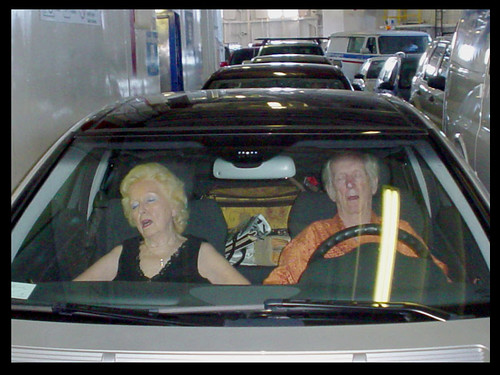
I guess I can generally agree with the findings of this study. It makes quite a lot of sense that elderly people who have a more difficult time in regulating their visual attention would be more restrictive of their driving excursions. The constant shifting and dividing of attention for what seems to be a simple drive must be really taxing on the older folks. With the inevitable decline of one’s vision and the eyes' ability to accommodate in older age because of the hardening of the lens and the weakening of the ciliary muscles, it is no surprise that older drivers usually choose to drive under better conditions. So even though some of these elder drivers may seem to have been alive when the wheel was invented, please, bear with them. Perhaps these lolos and lolas who believe they can still see well enough to drive are just exercising caution by moving at a snail’s pace, since they find it harder to pay attention to everything on the road and all.

He's probably just resting his eyes.


Okonkwo, O.C., Wadley, V.G., Crowe, M., Roenker, D.L., Ball, K. (2007). Self-Regulation of driving in the context of impaired visual attention: Are there gender differences? Rehabilitation Psychology, 52 (4), 421-428.

Images from:
http://chuvacosmo.blogspot.com
http://www.badlydrawnboysite.blogspot.com